
Whilst European industry is still struggling to recover from repeated energy and geopolitical shocks, Spain stands out as an exception. Its manufacturing output has surpassed its pre-war levels in Ukraine, driven by a more balanced industrial diversification, competitive labour costs and the boom in renewable energy. This is a promising trend, but one that still faces several structural challenges, particularly in terms of productivity and electricity infrastructure.
Key figures
- 43 %: difference in hourly labor costs compared with Germany.
- 58 %: share of renewables in Spain’s electricity mix in 2024.
Whilst Europe’s industrial heartland remains weakened by successive shocks, Spanish industry is proving more dynamic. Its resilience is underpinned by a diversified production base, competitive costs and strong energy potential.
The real challenge now is to convert these advantages into sustainable productivity gains.
says Laurine PIVIDAL, economist for Southern Europe at Coface.
An industry holding its own whilst its neighbors are falling behind
Since 2022, Spain has established itself as one of Europe’s most dynamic economies, with annual growth two to six times higher than that of the European Union. Industry is following the same trajectory: Spanish manufacturing output has already surpassed its pre-Ukraine war levels, whilst Germany and Italy are still lagging behind.
This performance can be partly attributed to a more favorable industrial structure. Whilst Germany and Italy remain heavily exposed to sectors hit hard by the energy crisis, such as the automotive, machinery and metalworking industries, Spain benefits from greater diversification and strong momentum in high value-added sectors (pharmaceuticals, electrical equipment, electronics) as well as in certain energy-intensive industries (paper, plastics, chemicals).
This momentum is not limited to the domestic market. Spain has maintained its export market share within the European Union since 2015, unlike Germany and France, which have seen their shares decline.
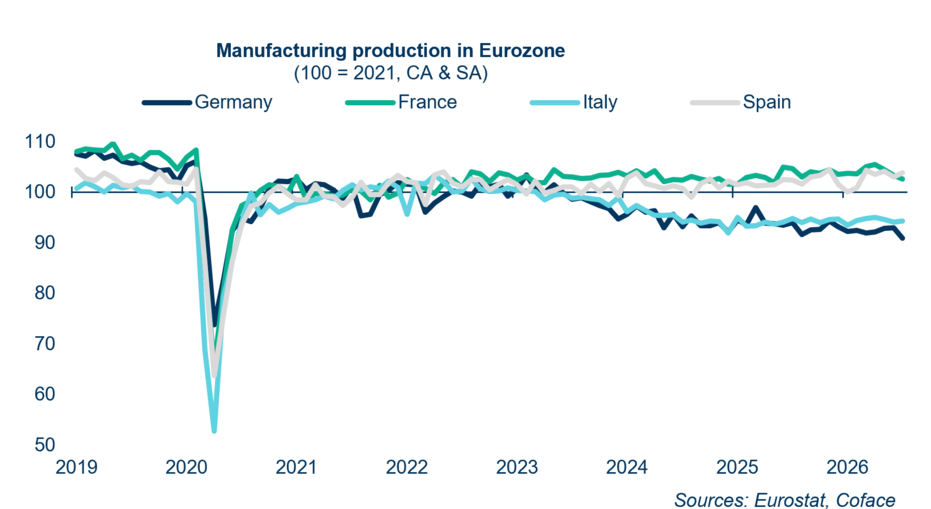
Data used for the graph in .xlsx format
A labor cost advantage, but under pressure
One of the main strengths of Spanish industry remains its labor cost advantage. In 2025, hourly labor costs in manufacturing will remain significantly lower than in other major European economies (40 % lower than in France and 43 % lower than in Germany). This gap enables Spain to remain particularly competitive: its lower labor costs more than offset its productivity shortfall.
However, this advantage remains fragile. Between 2022 and 2025, hourly labor costs in manufacturing rose by 15 %, whilst real productivity increased by less than 3 %. At the same time, job creation has been concentrated in low value-added sectors. The main risk is now clear: if wages continue to rise faster than productivity, one of the pillars of Spanish competitiveness could gradually weaken.
Energy: an under-exploited competitive advantage
In just a few years, the expansion of solar and wind power has profoundly transformed the Spanish electricity system. As a result, the country is now significantly less dependent on gas than most of its European neighbors, and gas influences its electricity prices for only 15 % of the time (compared with 89 % in Italy in early 2026). This reduced dependence lowers its exposure to energy shocks and helps make Spain the leading European market for PPAs, accounting for a quarter of contracted capacity.
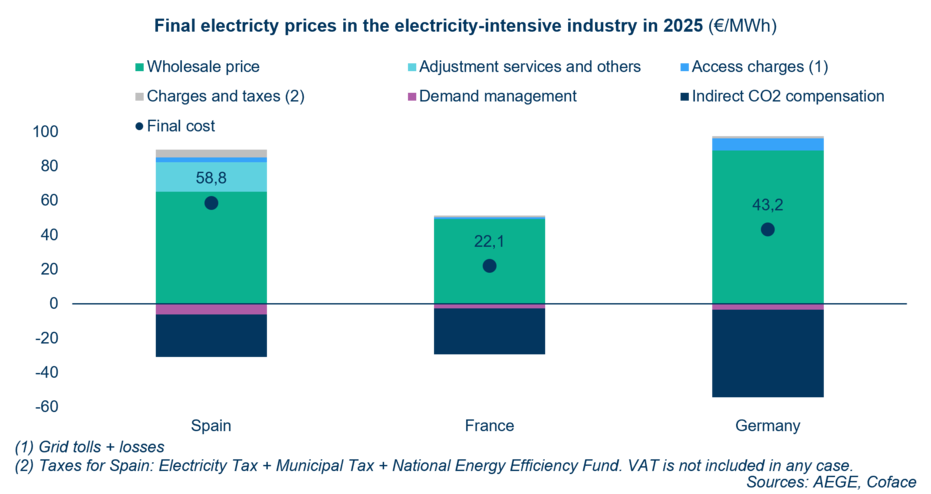
Data used for the graph in .xlsx format
However, this advantage in wholesale prices has not yet been fully reflected in manufacturers’ bills. The reasons for this include lower subsidies, higher grid costs and a lag in investment in electricity infrastructure and storage. Spain spends just $0.30 on its grid for every dollar invested in renewables, compared with around $0.70 in most European countries, which has led to up to 11 % of renewable generation being curtailed in 2025 due to grid constraints.
This potential could, however, be realized over the next decade. The planned phasing out in 2030 of German support schemes for energy-intensive industries, if confirmed, combined with Spain’s recent plan for an additional €17.9 billion in investment in the electricity grid, could strengthen the country’s competitive advantage. As industry decarbonizes, access to competitively priced renewable electricity could become an increasingly important differentiating factor in Spain’s favor.


